


Not too long ago, venturing through the world's most important city centers, one would inevitably encounter the American flag in some form — American brands, American food, American movies. The American way of life dominated the globe, and its reach remains vast. Recently, however, the American dream appears to be losing its charm.
During a recent trip to Europe, I found myself confronted with a new reality. While many countries openly resist American influence — and countless posters and pieces of graffiti made that very clear (as pictured below) — their people seem to have found comfort in a different symbol altogether.
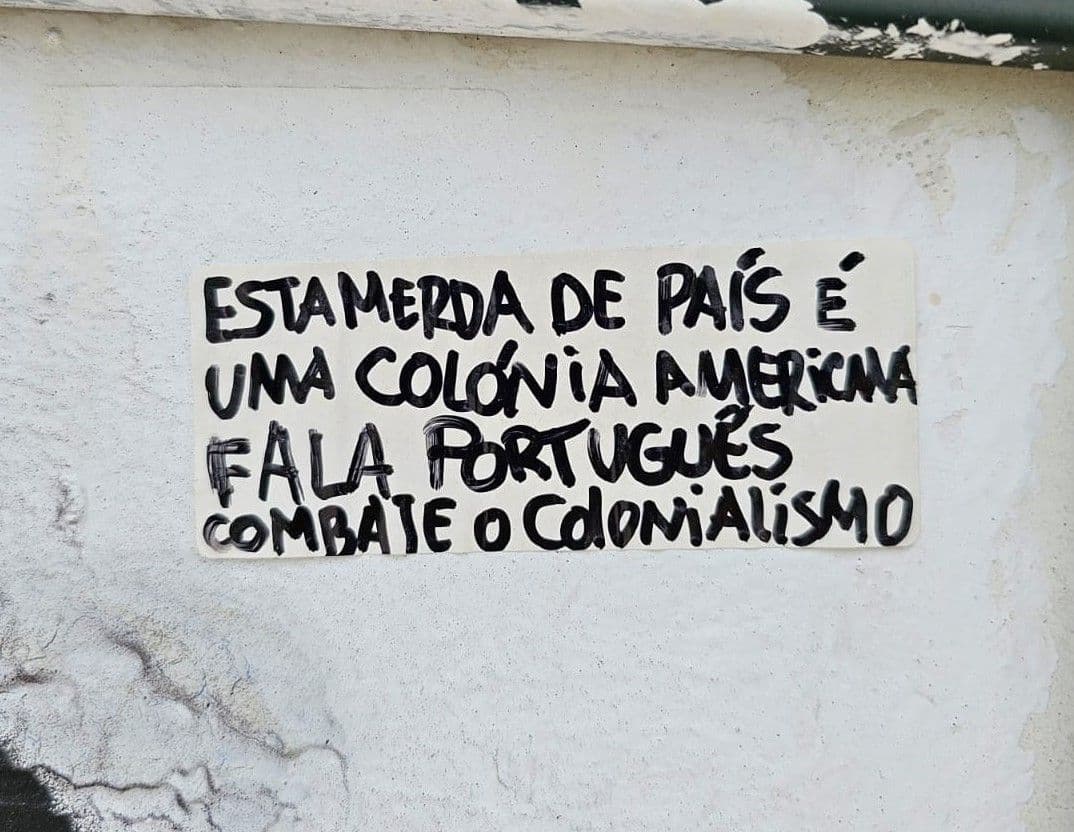
In every gift shop, alongside patches and keyrings of local flags and landmarks, one image kept appearing: the Brazilian flag. It wasn't entirely unexpected. A decade before, I had stumbled across Brazilian funk echoing through Times Square. With the rise of short-form platforms like TikTok and Instagram Reels, Brazilian culture has become increasingly influential. So when I found myself listening to the same rhythms at Bologna station, in the heart of Rome, it felt less like a coincidence and more like a pattern. I noticed people wearing Brazilian football jerseys who clearly didn't speak a word of Portuguese. I met Americans and Italians proudly sporting their Havaianas.
It seems the world has decided to take a page from Brazilian culture. The numbers back this up. In 2025, Brazil welcomed a record 9.3 million international tourists — a 37% jump from the year before, surpassing even the World Cup and Olympic years — a phenomenon analysts are already calling "The Brazil Effect."
People want to dress more freely, more colourfully. They want to leave work and meet friends on the sidewalk for a cold beer, or take an evening stroll along the beach as the sun sets. They want to stop worrying about wars, tariffs, embargoes and politics.
The Language Nobody Taught Them
There is no Brazilian equivalent of the British Council. No Institut du Brésil operating out of elegant townhouses in foreign capitals, offering language classes and curated cultural evenings. No state department quietly funding films, backing translations, or planting sympathetic journalists. When Brazil's culture crossed borders, it did so without a passport, without a budget, and largely without permission.
The French exported their language through schools, their cuisine through prestige, their philosophy through universities. The Americans came with Hollywood, with McDonald's, with the Marshall Plan — culture bundled neatly inside economic necessity. Soft power, in both cases, was inseparable from hard power. Every previous cultural empire arrived with infrastructure.
Brazil has none of those levers. It has no military umbrella to shelter under, no financial system the world depends on, no seat at the table where global rules are written. What it does have is something far less organised and far more contagious: a way of living that looks, at least from the outside, like freedom — and perhaps that is enough. No empire was ever built on perfection.
The path ahead
Rome was built on conquest and corruption. England's glory was inseparable from exploitation. France romanticised revolution while guillotining its own. America sold freedom to a world that overlooked its inequalities and contradictions for decades. A symbol doesn't need to be flawless — it needs to be compelling.
Brazil, then, does not need to eradicate poverty, solve inequality or empty its prisons before claiming its place on the world stage. Some degree of chaos, hardship and imperfection is the rule in human societies. The question is never whether problems exist. The question is whether a country appears to be trying to solve them.
Lessons of the Florentine
Here, we would do well to borrow from one of the great fathers of political thought. Machiavelli's most enduring lesson was not about power through force — as many nations, especially the United States, seem to be acting these days — but about the art of perception. To seem virtuous, he argued, is often more consequential than being virtuous. The same logic applies to nations.
Brazil's path ahead, therefore, is not merely a checklist of reforms. It is a narrative to be crafted and projected. It means showing the world the Amazon being protected, not just burned. It means letting Brazilian music, fashion, food and warmth continue to spill across borders — intentionally, not accidentally. It means leaders who, regardless of their private failings, speak to the world with the confidence of a country that believes in itself.
The world is already looking at Brazil with curious, almost hopeful eyes. That is a rare and fleeting gift.
Brazil must look back.


